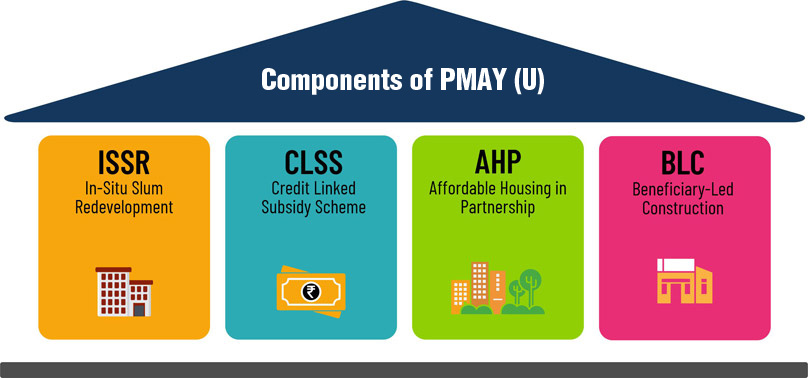
In pursuance of Government’s vision of facilitating Housing for All, Ministry of Housing and Urban Affairs (MoHUA), Government of India is implementing Pradhan Mantri Awas Yojana- Urban (PMAY-U) – ‘Housing for All’ Mission since 25.06.2015. The original mission period was up to 31.03.2022 which has been extended till 31.12.2025 for completion of houses sanctioned up to 31.03.2022, without changing funding pattern and implementation methodology of the scheme. The validity of CLSS vertical was up to 31.03.2022. Under the Mission, Ministry has been providing Central assistance to States/ UTs for addressing the housing requirement of the slum dwellers and other people belonging to Economically Weaker Sections (EWS), Low Income Group (LIG) and Middle Income Group (MIG) categories in the urban areas through following four verticals:
1. Beneficiary-led Individual House Construction or Enhancement (BLC): Under this vertical, Central Assistance of ₹1.5 lakh is provided to individual eligible families belonging to EWS categories.
2. Affordable Housing in Partnership with public or private sector (AHP): Central Assistance of ₹1.5 lakh per EWS house is provided by Government of India in projects where at least 35% of the houses in the projects are for EWS category and a single project has at least 250 houses.
3. “In-situ” Slum Redevelopment (ISSR): Slum redevelopment grant of ₹1 lakh per house is admissible for all houses built for eligible slum dwellers under the vertical of In-situ Slum Redevelopment using land as Resource with participation of private developer.
4. Credit Linked Subsidy Scheme (CLSS): An interest subsidy of 6.5%, 4% and 3% on loan amount upto ₹6 lakh, ₹9 lakh and ₹12 lakh were admissible for the eligible beneficiaries belonging to Economically Weaker section (EWS)/Low Income Group (LIG), Middle Income Group (MIG)-I and Middle Income Group (MIG)-II respectively seeking housing loans from Banks, Housing Finance Companies and other such institutions. (CLSS for MIG was from 01.01.2017 to 31.03.2021)
The Mission is implemented as a Centrally Sponsored Scheme (CSS) except the CLSS vertical of PMAY-U which is implemented as a Central Sector Scheme.
BENEFICIARY FAMILY
A beneficiary family under the Mission comprises of husband, wife, unmarried sons and/or unmarried daughters. The beneficiary family should not own a pucca house (an all-weather dwelling unit) either in his/her name or in the name of any member of his/her family in any part of India. An adult earning member (irrespective of marital status) is treated as a separate household provided that:
- He/she does not own a pucca (an all-weather dwelling unit) house in his/her name in any part of India.
- In case of a married couple, either of the spouses or both together in joint ownership will be eligible for a single house, subject to income eligibility of the household under the scheme. An eligible beneficiary can take advantage of only one of the four verticals of the Mission.
- Further, such person with pucca house having built-up area less than 21 sq.m may be included for enhancement of existing dwelling units upto 30 sq.m. However, if enhancement is not possible on account of lack of availability of land/space or any other reason, she/he may get a house under PMAY(U) elsewhere.
SALIENT DETAILS
Flexibility to States:
- Cafeteria Approach: States/UTs were free to choose any vertical of the Mission to meet their demand of housing
- Demand Based Approach: Housing requirement based on demand assessment by States/UTs
- Appraisal and Approval of projects at State level
Ownership of House:
- House to be in the name of adult female member or in joint name
- Preference to persons with disabilities, ST/SC/OBCs, Minorities, Transgender and women (with overriding priority to widow)
- All houses to have drinking water, power supply, sewerage and toilet facility
Coverage:
- All statutory towns (Census 2011) and towns notified subsequently
- Notified Planning Areas and Notified Development Authorities (excluding rural areas)
- Areas falling within notified Planning/Development area under the jurisdiction of an Industrial Development Authority/Special Area Development Authority/ Urban Development Authority or any such Authority under State Legislation.
MONITORING MECHANISMS
PMAY-U Dashboard
The dashboard has key information related to all the physical and financial progress of the Mission. It displays project wise data of all the houses under the Mission through easy-to-understand indicators. The Dashboard has information related to State/ULB-wise sanctioned houses, the current status & the timeline of the project- execution/ occupation stages, release of Central Assistance, status of utilization certificates, project timelines, graphical view of various stages of execution, etc. Centre, State/UT/City level Login IDs have been created for all stakeholders enabling them to have day-to-day status of each project in the respective State/UT. This helps each of the Implementing Agency to identify lags in performance of the project, and rectify the issues for better implementation.
Management Information System (MIS)
A comprehensive and robust Management Information System (MIS) has been developed which helps all stakeholders to seamlessly manage information pertaining to physical and financial progress. The MIS allows submitting on-line demand survey with tracking facility and helps in housekeeping of various records through digitization of survey data, project information, beneficiary details, fund utilization, etc. MIS has also been integrated with CLAP for real-time monitoring mechanism, UMANG Mobile App, NITI Aayog Dashboard and DBT Bharat Portal for dissemination of information. The MIS has also been linked with the MIS of Pradhan Mantri Awas Yojana-Gramin (PMAY-G) for verifying duplication of beneficiaries.
Direct Benefit Transfer (DBT)
The transfer of the Central Assistance and State/ULB share to the beneficiaries of the BLC vertical of the Mission is being done by States/UTs through DBT mode where the instalments are credited directly into the beneficiary’s bank account as per the geo-tagged stage of the construction with PFMS and GIS based MIS, etc.
Geo-Tagging
MIS is equipped with five staged Geo-tagging features and integrated with BHUVAN Portal of National Remote Sensing Centre (NRSC) and BHARAT MAP of National Informatics Centre (NIC) for monitoring the progress of construction of houses under the BLC, ISSR and AHP verticals. Images of geo-tagged houses as moderated by States/ UTs are available in public domain.
CLSS Awas Portal (CLAP)
CLAP has been designed, developed and implemented to provide a transparent and robust real-time web-based monitoring system for CLSS beneficiaries. The CLAP software works in tandem on a real-time basis with the UIDAI, CNAs, PLIs and PMAY-U MIS system for Aadhaar validation and de-duplication with other verticals of PMAY-U. The component of CLSS has been closed on 31.03.2022.
PMAY-U Mobile App
The application is being used under PMAY-U for dissemination of information and capturing the emotions of beneficiaries through photographs/video testimonials.
TECHNOLOGY SUB-MISSION (TSM)
TSM was set up under PMAY-U with an objective to promote ‘Sustainable Technological Solutions for faster and cost effective construction of houses suiting to geo-climatic and hazard of the country. The Global Housing Technology Challenge- India was initiated in 2019 to identify and mainstream globally best available proven construction technologies that are sustainable, green and disaster-resilient to enable a paradigm shift in affordable housing sector. The major activities under GHTC-India are as follows:
Light House Projects (LHPs)
As a part of GHTC- India, six LHPs, comprising of around 1000 houses each, have demonstrated construction of ready to live houses using alternate and innovative technologies. The LHPs have served as live laboratories for different aspects of transfer of technology to the field which includes planning, design, production of components, construction practices and testing. The objective is to mainstream the globally identified proven innovative technologies under GHTC-India in Indian context.